


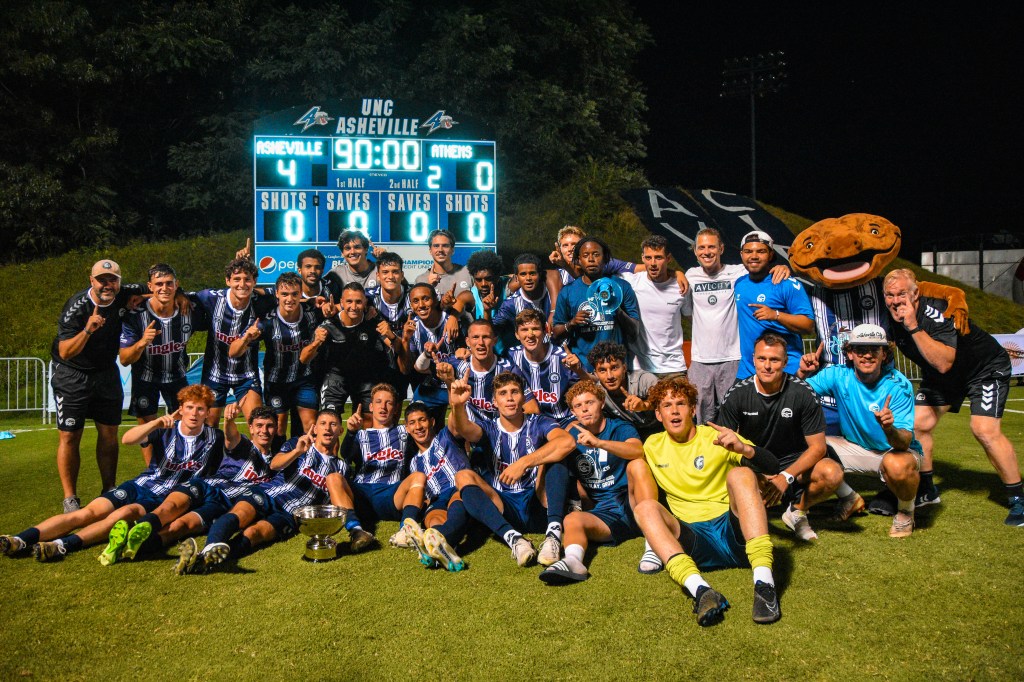
For Guy Campbell, giving back to soccer in Asheville is personal.
Long before he was coaching at Christ School, working with Asheville City SC or helping run Carolina Colortones, Campbell was a young player in Black Mountain trying to figure out where soccer could take him. One of his first opportunities to see what that next level looked like came through his father, who sponsored an adult league team that traveled around the Southeast to play six-a-side tournaments. Campbell, who was only around 12 at the time, was occasionally able to join the team and play alongside college players.
“I was able to be around that, and I think because my dad was able to sponsor that team and sponsor those players, I was kind of introduced to really what real soccer looks like at a very young age,” Campbell said. “I think that was really beneficial for me and my development.”
That experience stayed with him. Campbell went on to play at Christ School before playing four years at Presbyterian College. When he returned to Asheville and began working at Carolina Colortones around 2010, he started thinking about how he could provide some of the same opportunities for the next generation. “I got a bug to essentially pay it forward a bit,” he said.
More than a decade later, that idea has become a big part of Campbell’s life. He is now the Soccer Program Director and Varsity Soccer Head Coach at Christ School, where he has built one of the area’s most successful high school programs. He has also been involved with Asheville City since 2019 and has spent the past five summers as an assistant coach with the club’s USL League Two team. Through Carolina Colortones, he and his family have continued to support Asheville City as well. For Campbell, those aren’t separate pieces of his life. They all connect through the same goal: giving local players a chance to see how far they can go.

Keeping Good Players Here
Campbell sees one of the biggest challenges facing young soccer players in Asheville as a lack of access to the next level. For players who want to pursue the sport at a higher level, leaving the area has traditionally been part of the process.
“There’s a missing piece to the youth soccer player here in Asheville, where essentially, if you want exposure, you have to leave,” Campbell said.
That was one of the reasons he was so interested in Asheville City’s academy when it was launched. The opportunity to bring some of the area’s best young players into the same environment as experienced coaches and players was something he felt Asheville needed. The hope was always that those players could eventually make their way to the first team, not simply because they were local, but because they had developed into players who were good enough to be there.
Campbell has started to see that pathway work. Last year, four Christ School players went on to play college soccer, including one at the Division I level and three at the junior college level. Two more players received Division I offers as juniors, with one committing. Campbell said the common thread among those players was their involvement with Asheville City’s academy and their opportunity to work with the club’s coaches.
“They were all ready to go play, and they were all ready to contribute,” he said. “And the neat thing is, the mainstay within all those players was that they were involved in Asheville City’s Academy.”
That is particularly meaningful to Campbell because opportunities like that were not necessarily available to him when he was growing up. When he was trying to navigate the college recruiting process, having a high school coach with strong connections made a major difference. “If it wasn’t for my high school coach’s brother, I don’t think I would have got the benefit of the doubt to be able to go play anywhere,” Campbell said.
Now, he wants young players in Asheville to have people who can help them answer those same questions: Where do I fit? What level can I play? What do I need to improve? What should I be doing next? Campbell believes Asheville has more people who can provide those answers than it did when he was a player.
“Being someone from this area, and one of the reasons I’ve wanted to get back, give back, and get involved is, do you think there are good players in Asheville?” he said. “But they need to develop that mentality, and Asheville City is a great avenue or a great asset to have to try to help build that.”

More Than What Happens on Game Day
Campbell’s work with young players has also changed the way he evaluates them. Talent matters, obviously, but after years of coaching, he believes the biggest difference between a good player and a truly high-level player often comes down to mentality.
He sees it in the little things. If a team has a game on Saturday, what does a player look like in training on Monday, Tuesday and Wednesday? How seriously do they take their preparation? How do they treat their teammates? How do they respond when things aren’t going their way?
“It’s not just how a player plays in a game,” Campbell said. “But if there’s a game on a Saturday, what’s the player look like in training on Monday, Tuesday, Wednesday?”
Those are the things Campbell talks about with his players at Christ School, where the focus extends beyond simply developing better soccer players. He has seen that approach pay off, with more and more of his players finding opportunities to continue playing after high school. Because of his work with Asheville City, he has also been able to see what players need to do to reach that next level.
“When it comes to top players, their mentality, that’s what makes them a top player,” he said. “Because I think once you get to a certain level where everyone’s really good, what makes a bunch of really good players different?”
For Campbell, that understanding is one of the most valuable things he can bring back to young players in Asheville. He has now seen the game from several different perspectives: as a local player, a college player, a high school coach, an Asheville City coach and someone involved in the development of young players throughout the region.

A Family Connection
Campbell’s relationship with Carolina Colortones and soccer goes back even further than his own playing career. His father was the one who originally sponsored the adult team that gave Guy some of his earliest opportunities. When Campbell returned to Asheville and began working at Carolina Colortones, he eventually helped bring the company back into the local soccer community.
Today, Carolina Colortones is a longtime Asheville City sponsor and an important supporter of the club. But for Campbell, the value of that relationship goes well beyond a traditional business sponsorship.
For his family, supporting soccer has always been about investing in something they believe in and helping create opportunities for players throughout Western North Carolina. “It just continues to check that box of it’s something that my dad was really passionate about,” Campbell said.
That passion has carried over to Campbell and his brother, who remain invested in soccer throughout the region. For Campbell, being involved means more than simply talking about what could be better. It means putting that belief into action and supporting the organizations, players and coaches working to build a stronger soccer community.
“The biggest thing we want to be seen as is we’re not just people that complain or talk about, you know, ‘Oh, if I did things, I would do it like this,’” he said. “We just are kind of like, ‘Hey, you know, we actually want to help.’”
That is where Asheville City has been important to him. Campbell said his family has extended its hand to the local soccer community multiple times, but Asheville City has been willing to take it and find ways to put their experience to work.
“Asheville City has been the only club that’s put their hand back out and said, ‘Hey, you know, we think you guys can help us,’” he said. “And so we’ve been very grateful for that.”
The relationship makes Carolina Colortones more than just another name on a sponsorship list. Campbell has coached Asheville City’s players, helped identify local talent and spent years working with young players who could eventually reach the club’s first team. His work at Christ School gives him another place to help those players develop, while his family’s support through Carolina Colortones helps the club continue creating opportunities for them.

Looking Ahead
Campbell doesn’t think the work is finished. If anything, he thinks Western North Carolina has an opportunity to do much more for its best young players.
His ideal future would involve the area’s soccer clubs working more closely together, particularly once players reach high school age. The best players, regardless of which club they come from, could train together and regularly compete alongside older players.
“The best way to develop a 14- or 15-year-old player is to have them training with 18-year-olds,” Campbell said.
He sees Asheville City as potentially playing a central role in that process because of the club’s first team and the environment it can provide. There are plenty of challenges to making that happen. Youth soccer is complicated, and the pay-to-play structure means different clubs have different needs and responsibilities. But Campbell thinks it is worth continuing to look for ways to put the best interests of the players first.
“My hope in five years is that Asheville City’s maybe more full time able to offer something for those top youth players,” he said. “Because if not, then I don’t know. It may look exactly the same as it looks now, which is okay if that’s it. Because we still have, we’re still producing really good players. I just think we could do better.”
For Campbell, that is ultimately what all of this comes back to.
He had people who opened doors for him when he was young. Now, he wants to be one of those people for someone else. That might mean coaching a player at Christ School, helping identify a local player for Asheville City’s first team, connecting a young athlete with the right college opportunity or supporting the club through Carolina Colortones.
The role changes, but the goal doesn’t.
Give local players a chance. Help them understand what comes next. And, whenever possible, give them an opportunity to pursue it without having to leave home first.
For someone who has spent much of his life around Asheville soccer, that’s a future worth investing in.